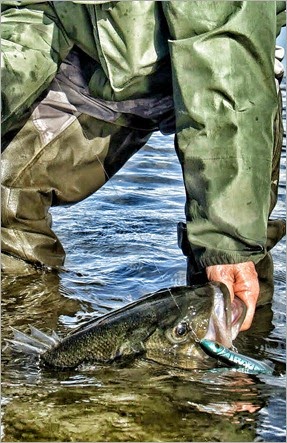
Showing posts with label Bass Fishing Catch and Respect. Show all posts

Thursday, 25 January 2018

Guiding For Bass - Not all locations are equal

The key to any successful and sustainable tourism initiative is achieved through a clear sense of difference from other competing destinations or services. For me as a bass fishing guide this was achieved by basing any development and marketing strategy on the local attributes and strengths of Wexford as a bass angling destination. This was combined with the unique varied and challenging angling coastal environments, heritage sites and abundant local flora and fauna including of course the fish. It was within this world that I chose to guide for bass on a full time basis.
Working on articles for angling publication or my site I attempted to portray both Ireland and Wexford in a very positive light. Whilst delivering my workshops or whilst guiding for bass this was done in a fashion that emphasised the importance of ‘where we were going’. I tried to achieve this by making the most interesting photographs and words that I could, not only of the fish but of the people who were fishing with me capturing the environment and time in which they found themselves either being guided or during learning . There are many things other than fishing that make any trip to Ireland worthwhile, and it was important for me to remember that when I was out there working as a guide. Not only was I looking to capture that ‘trophy’ moment, but I was also hoping to record the influences, the many different environments that were shaping peoples experiences of the country in which they were investing a lot of personal time. The culture, the lifestyle, the history of Wexford all played a part in shaping a sense of authentic service.
Not only was it important for me to realise that each experience was unique, but by spending time in many of the different bass fishing environments and places of local heritage and culture enabled people to understand the interdependence and influences that one environment has upon another. It is only through this understanding and wider sense of enjoyment that a much greater appreciation and understanding, advocacy and empathy for the protection and conservation of the coastal resource in all its aspects  truly developed in peoples minds.
The richer the experience that was offered to the guided angler the greater was the chance of diversification into the local community and the support of ancillary services. Good food, good traditional music, immersion in modern Irish life, quality Irish made product, indeed visiting anglers couldn’t find this ‘uniqueness’ at home, hence it created a special trust between guide and angler. The foundation of  any guiding service.
However, I was always conscious that over-selling a product could have a negative impact on any business, especially a fishing guiding service. Angling guided services should not to be encouraged or developed for their singular sense of ‘self promotion’ ‘look at me I’m a guide’.  To be successful as a guide is to be many things but bass guiding in Wexford was mainly about not standing in isolation but rather about building a small community based economic and local development tool aligned to creating a total ‘local’ and sustained experience.
There needs to be a reduction in the the modern craven urgency expressed frequently in the over utilisation of angling journalism and various media as a means to secure customers or build 'angling credibility'. A decrease of the obsessive culture of ‘self with fish’ portraits or look at my new gear obsessions might serve long term and sustained development better rather than quick fix ego shots.
The facilitation of manipulated social media reportage that serves no real end in achieving competence proves ultimately fruitless and in fact damages the fishery.
There’s a fine line between selling the fishing and managing the corresponding impact on your future clients realistic expectations. A good guide will always try to strike that balance especially when linked with important locations, the fish that live there and their continued protection management.
Not all locations are equal...hard choices and decisions need to be made with long term sustainability in mind.
The careful management of my guiding service into other local tourism networks and taking sensible opportunities to work and demonstrate allegiance with other local similar businesses with diverse but related experience and knowledge (fly tyers, fly casters, other guides, or accomodation providers) was a large part of business development for me. This strategy even today projects confidence, enhances profile and indeed professional credibility. It also strengthens possible partnerships that can create foster and extend networked interdependent strategic relationships across local coastal communities, conservation groups and activity providers. 
The Wexford environment doesn’t possess dramatic, jaw-dropping scenery. It doesn’t have the ruggedness or sense of wilderness that you get on the west coast. It doesn’t have outstanding architecture. What Wexford does have is a multiplicity of different smaller environments and opportunities that are much more complex and which interact in a way that is so subtle it can almost be overlooked. 
You must look closely, almost discover each one be it cultural, natural, or historical in order to experience the fullest and greatest depth of detail. To be transformed by the time invested.
Ultimately an ‘experience’ a ‘transformation’  is what I tied to create for my angling customers, the readers and visitors to my blog. By facilitating people into a multiplicity of venues, the sanctuary of estuaries, the excitement of rocky shores, the thrill of fast moving, powerful currents, the more likely they were to see and feel the ‘Wexford Bass Angling Experience’ that I tried to create.
“EVEN AFTER SPENDING A LIFETIME OF FISHING FOR BASS IN THESE VENUES I REALISED EVENTUALLY THAT WE WERE SIMPLY SCRATCHING THE SURFACE OF POSSIBILITY, IT WAS BOUNDLESS IN TERMS OF TECHNIQUES, METHODS, PRESENTATIONS…”
Most seasoned travellers will know that to expect too much is to invite disappointment. “There are not as many fish as I expected”, “The fish are smaller than I expected”, “The weather is different than in my own country”. The weather is the major stage on which all the elements will perform. In Ireland that factor is enough to strike fear into the heart of any guide. It’s simply not possible to plan at times. Some seasons were extremely difficult for bass fishing. And this is where the paradox lies. Wexford has its own unique environments, it has its own sense of itself and it has a superb saltwater sporting fish that performs admirably on fly or lure. But it performs only on the basis of two key elements one which is predictable (the moon) the other (the weather) is not so regular.
The portrayal of the fishing and the fishing environment must always reflect a performance risk accurately and fairly to visiting anglers.
We all know yes, that at different times bass can be caught with many different methods. All anglers have their preferences and the more sporting the method employed the more the weather will impact negatively upon that method. It will force you into circumstances where you need to ‘angle’ much more creatively and efficiently. By combining the environmental impact and the challenges that the weather creates for lure and especially fly-fishing, this fusion of influences must somehow manage to enhance the experience by transforming the customer beyond the angling difficulty. 
What is achieved easily in bass fishing is often forgotten quickly with little or no understanding of its significance, this is true of technique, local information and angling presentations. There is always much more than this that needs to be experienced. We need to be transformed to fully understand the larger picture.
In other words, it was not always easy for an international bass angler to come to Wexford to catch bass at the drop of a hat. It could take time and effort, patience and depending on circumstances this could have been days, weeks or even years.
When it was difficult it was always the smaller decisions, the glimpses of fish in a wave, the perfect cast into a gale, the surface strike in pouring rain –moments of genuine satisfaction that made the fishing what it was. Don’t be fooled into thinking that it was easy, it was not! At times the sun shone and every fish was big and silver and each cast produced a miracle. Those were the days that we fished for.
But remember too – Wexford was and is currently challenging, but it has many different rewards if you know where to look. If you like to discover whats local and unique and what will ultimately transcend less important things then remember too what can truly transform you
‘AT THE TIMES THE SUN
DOES SHINE AND EVERY FISH IS BIG
AND SILVER AND EACH CAST
PRODUCES A MIRACLE, OR NEARLY, AND MEMORIES ARE FORGED IN GOOD COMPANY AND SURROUNDINGS.
IS IT HOW YOU GOT HERE?
OR IS IT ALWAYS THE FISH? ’

Friday, 5 December 2014

A Journey 2004 - 2014


Bass fishing with Jim Hendrick

Using various strategies to get your business and services ‘visible’ is beyond doubt essential. In todays world that definitely means using social media tools, websites, mobile friendly accessibility, and a strong reputable and credible online presence.

The use of ‘Feature’ articles in angling publications is one of those strategies that I adopted early in 2003 through the advice of David Byrne. The first International ‘Feature’ that effectively portrayed the potential of South Eastern Irelands bass fishing appeared in VoyagesdePeche in 2004 (here). Nico Jamin was the chief Journalist working with the magazine at the time and his photos feature in the article.

Julien La Journade the editor in chief of the magazine has a close and highly developed relationship with Irish angling promotion. A constant champion of many guides and services in this country Julien has done me many small promotional ‘unprompted favours’ over the past ten years. Subtle in context, a paragraph here a photograph there, just enough to keep things ticking over.

I have been very lucky with the journalists I have had the opportunity to work with over the past ten years. When I want to work with somebody I’ve already made the decision on the basis that I know that their objectives are based simply in carefully promoting the angling, the local support services and of course the guiding as provided by Jim Hendrick. Here’s the kicker though, many angling journalists are interested in promoting themselves and their angling prowess in preference to either the fish the environment or the services. This is often achieved by being facilitated into positions of angling opportunities that they could have never ever dreamed of experiencing!

bass fishing in IrelandI have been careful and lucky too.

But I’m guessing now that this is always the case, there’s always a little bit of quid pro quo, and that’s fine until you find their friends are casually ‘guiding’ on places where you have worked for years to develop. Somehow the quid and the quo are not the same.

The something special about Julien LaJournade is probably in his passion, his depth of understanding of both what it means to be a genuine fishing guide whilst being aware of the impacts of local recreational angling and the associated risks of over development of any fishery in many environments. I have learned to believe that these are some of the characteristics of quality angling journalism.

My personal strategy with magazine features was to use many different International publications across many countries over time. Coupling this to reporters who viewed Wexford in the same way as Guinea Bissau, Gabon or Norway and that in these places were unique fishing possibilities available to you if you used a local fishing guide – simple, this is their job. I know how to do mine.

Julien returned to Ireland this year and we worked on an article for his magazine. We had an incredible week. Both tough and at times awe inspiring. I find it appropriate now as I change my life and my angling, again, that the magazine I started with in 2004 (as above), the first of its kind to visit South East Ireland and particularly Wexford,  is the one I close with for the time being.

Bass fishing

So much has changed since then. The magic of technology and photography has moved so much that these photos here were taken on my mobile phone, unheard of in 2003! Some of these and more feature in the latest edition of  Voyagesdepeche.

Julien has completed 9 pages of an article about his latest experiences of Irish bass fishing on the wild coast of Ireland guided by Jim Hendrick.

Julien is a balanced writer, a great lure fisherman and someone who has inspired me never to get engaged in the online bullshit of expertise that’s so prevalent around bass fishing.

I believe that not everyone has agreed with what I did as a guide, I tried to do my job as best as I could and with as many like minded people as I could find. I’ve had incredible bass angling experiences and I have been lucky to have shared some of those times with great angling journalists. Journalists who have done bass fishing and Ireland proud.

Thanks to you all – Jim Hendrick

Tuesday, 8 July 2014

The beginning AND the end…

Forwarded to - The Irish Bass Policy Group (David McInerny, John Quinlan, Shane O Reilly, Mike Hennessy, Dr William Roche, Dr Nial O'Maoileidigh,) Malcom Gilbert, several members of the IFI and other home based bass fishing customers.
_______________________________________________________________________
I am writing this letter to call to your attention the serious concerns I have for the continued deterioration of the bass population as I have experienced it on the south and eastern coasts of Ireland. As you may know I have fished these coasts on a recreational basis since 1975, I am a bass fishing guide working and developing bass fishing on these coasts on a professional basis since 2002/03. My business South East Angling Ireland was established to provide both guided bass fishing services (fly and lure) and approved accommodation with a view to a holistic approach to the fishing, including airport transfers, provision of modern tackle and singularly strategic bass fishing solutions.

The profile of the traveling, affluent, adventurous and experienced European sportfishing angler was where my target customers lay and whilst historically Wexford may have had a small heritage in relation to bass angling the challenge for me lay in both attracting the correct customer whilst simultaneously demonstrating responsibly the remarkable accessible ‘new’ bass angling environment available in Wexford through my services.

This was a considerable business challenge as Iconic locations like the Kerry coast, the Dingle peninsula, still attracted by default traditional bass angling interests. Added to that challenge the profile of my customer needed to be correct in order to maintain a high level of ‘impact distance’. This meant that customers came to Wexford, fished for a week and left, simple. The likelihood of ‘local interest growth rate/impact’ was minimised.

Inclusive of the years 2003 – 2007 this was largely achieved through keeping a tight lid on advertising of services which was directed entirely at a European and US target audience through various magazine editorials. These were wide ranging and spread with the help of IFI and Failte Ireland between France, Germany, Italy, Holland, Belgium, the US and Denmark. Up to this time, end of 2007, both the Irish and UK markets were not where I felt large number of ‘profiled’ customers lay, the market didn’t exist in the UK at this time as ‘modern’ bass lure fishing techniques only began to develop there from late 2007 / 08 in both the UK and Ireland.

I made a considered business decision that any associated ‘local’ advertising would have had a negative impact on my business through creating access to awareness and hence increasing ‘local recreational angling’ impact. Wexford is easily accessible.
However I did feel it necessary at the end of 2007 (for many reasons) to begin to increase the public awareness of the actual existence of an approved bass fishing guiding service and expertise that was available in Ireland at this time. I did this through Irish Angler Magazine, 2007-20011 inclusive. This was also achieved through the active development of my website www.probassfisher.ie from the beginning of 2008.

The core strength of the business lay in the availability of the fish along the SE coast in a multitude of exciting and different locations. Coupled to that was the strategic angling solutions I provided in order to catch the fish effectively (based on thirty years of local experience), the quality accommodation I provided in Wexford town and the accessibility to local support services.

Pre business establishment ‘test cases’ were run to establish the validity of the availability of the fish across the multitude of locations along the Wexford coast - estuaries, current, rocky shore, deep water, sand bars, etc.

The rate of return was calculated very simply as I spent more and more days fishing with customers the key catch base was running at an average of fish per hour per customer. In some locations this could be as high as 8 in others as low as .5 – this depended on the type of location, timing and also the size of fish anticipated or targeted. This was communicated to the customer in relation to their expectations on a day by day basis, but always ‘under estimated’.

It is also important to note that years prior to opening the business this base was strongly in evidence.
The factor that most changed these numbers in relation to catch return at any time was weather of course but this was always a minimal impact on a general day by day basis with the odd exceptional week of complete wipe out.

Location footprint and location frequency was kept to a minimum as I fished across an empty coastline for five years.
The base calculated from 2002 (intro only), into 2003 (beginning), and through the following years 2004, 2005, 2006, and 2007 remained within 15% +/-25% of my expectations for customer returns. When it didn’t it was always attributable to other external factors.

The operational constraints of the fishery were recognised and established from year one of the business. Growth was restricted by the tidal environment but customer yield was kept high to maintain validity of financial return. There was always the option of an offshore boat to realise the potential of neap tides but this venture has not been pursued as yet. This would effectively increase the business by 50 %.
It is important to know at this stage the weekly guiding service only ran on optimum tidal times (alternate weeks) – approximately 70 days. This was extended at times to over 100 days when conditions were better earlier and later or combined with workshops. This is probably the fullest valid guiding window of opportunity for the south east.
One week June
Two weeks July
Two weeks August
Three weeks September
Two weeks October

On average a visiting group consisted of two people and the majority, 95%, up to this time (2007) were very experienced lure fishermen.

Fishing six days a week for two people at a base of 1.4 fish per hour averaged a seasonal return for 1200 fish. (+/- 200). Many of these fish occupied a similar size bracket. Taking into account the many variables some weeks consisted of only one angler some weeks consisted of three anglers and some weeks were more difficult than others from a perspective of weather, this high return rate NEVER deteriorated below a valid key catch base of average 1.0 per hour for nearly five years.
During 2007 the return rate for the second half of the season deteriorated suddenly by 50% and more (this was under normal expected angling conditions and customer profile) It was also the first of a sequence of very wet summers.

Based on catch returns during the years from 2008 2009 2010 2011 2012 2013 and including 2014 to date the catch rate has declined and has continued to decline on a yearly basis to the extent that the recreational bass fishery along much of the south eastern coastline has in my own experience suffered a complete ‘collapse’.
*During 2011 there was an indication of some improvement, however 2012 proved worse than 2010.
For a typical example of this, as it has continued from as early as last week, - Two UK anglers from Wiltshire – lure fishing for six days guided by myself under the best times locations and conditions in Wexford, Waterford, and Cork investing a combined 120 hours of fishing effort for one fish caught – TOTAL. This is now not unusual.
Prior to and including 2007 for the same investment of 120 hours somewhere in the region of 120 fish could easily be expected as a return.

The above scenario is repeated time and time again and the expected return rate has gone from
1.3 fish for one hour investment
TO
1.0 fish for thirty hours of investment – this varies but never significantly increases and hasn’t done so for more than seven years. The fishery has continued to decline very quickly.

Notes - Anglers
• Fish can be caught at times in much localised areas (for instance Splaugh rock) – reefs, current and structure at very specific times. This is not testament to the fishery as a whole. In other words vast areas of coastline hold no fish where previously there was a healthy population
• Local ‘expert’ anglers can have access to these fish but this should not be confused with the ‘general’ bass angler who should at least be enjoying a modicum of success
• Similarly boat angling over offshore reefs or at the mouth of estuaries with soft plastic techniques is not representative of the fishery as a whole
• Depending on the year of beginning to bass fish (the new generation of anglers) the entry was made on a sliding scale if made post 2007. In other words I encountered very few if any bass anglers on the Wexford coast prior to 2007 whilst post 2007 this number increased locally year on year – valid comparisons regarding the fshery need to be made over valid time frames.
• It’s possible for an angler to express ‘good bass angling experiences’ say in 2012 if he started in 2010 – this is not a valid comparison

Notes – Locations / habitat
• There are two extremely special locations on the Wexford cost that still have a population/ number of very big fish – these are very small and difficult to determine locations which may in time help preserve them from rampant local recreational pressure.
• I have guided on these locations once a month for two hours on previous years but will no longer continue to do so
• Modern lure fishing techniques create easy access to larger mature breeding fish of which there is a high angling impact
• All possible high yield locations on the south eastern coasts are now common place knowledge
• Social media quickly highlights any availability of fish on any location

Notes- Illegal fishing and retention
• Whilst there is a lot of catch retention I do not believe it is responsible for the decrease in numbers (there is a high recreational impact however both from poor C+R and retained fish)
• Whilst there is a lot of continued localised illegal netting this has been in existence for many many years, it does have an impact but I don’t believe this has increased by any significant level to cause such a decline in the Wexford region.
• There is evidence of increased and continued illegal netting on the East Cork coast
• Spearfishing is also increasing in popularity
• There remains the extended periods of bad summers 2007 2008 2009 and 2010 combined with two significantly extreme winters which amounted to an extended period of five years ‘poor’ conditions. Whilst I have no scientific evidence of the possible impact on the dynamics of the fish my instinct is that the SE bass population may have moved as a result and to where it was subsequently impacted upon commercially.
• Certain sections of the angling media will portray the quality of the bass fishing as being extremely good whilst neglecting the valid unit of effort (often extraordinary)required to produce any fish. There is often no management in respect of these special locations where large fish reside and a tendency to ‘forget’ the lack of fish on the wider coast.
• Genuine anglers on the ground with good and valid experiences are recognising similar instances.

Conclusions
Since 2003 over three hundred tourist anglers from Europe and the US have used the services of SEAi for guided bass fishing in Wexford. Easily twenty different publications have published positive editorial of their experiences distributed throughout many countries. Video footage has been made and distributed. Many Irish and UK people have attended intro Bass fishing workshops and perhaps as many as half again have partaken in bass fly fishing workshops. Numbers of guided Irish and UK customers remain small with less than ten active people.

Recent 3- day workshops include partnering with Irish fly casting and fly tying experts providing a total saltwater fly fishing solution.

The current situation is certainly a very difficult challenge for me and my business due to the decreasing numbers of fish. And to be honest here there’s no avoiding it, bass are largely absent from our coasts at this time. Talking about it openly has its risks and of course its own complications regarding the possible reasons any or all of which could be a cause for their absence.

Whether it be a natural phenomenon, a change in behaviour or something more serious it’s largely extant around the normal prolific ‘bass coasts’ at this time. For me I need to strike the balance between fairness and expectation with customers currently arriving at my door.

Again yes there are fish to be caught but the unit of effort is enormous, has been for weeks and weeks, in fact years, seasons. I have been personally motivated over the last twenty day run by the positive attitude of my customers, their eagerness to learn new techniques, presentations, casting, and even new locations. As a bass fishing guide I have had to push all my timings, options, variations in equipment and solutions, techniques and experience to be at its very best.
But two anglers for 120 hours of effort for one fish doesn’t make any sense from an angling business perspective. And this is not a singular story but commonplace at this stage.

As a person who largely makes his living from Guided Bass Angling well I guess it’s a very different and worrying perspective than that of a recreational angler. In an unregulated environment mercenary guides from both Ireland and the UK appear and disappear often offering various business models founded on reduced rates or a no catch no fee basis – this does nothing for the guiding occupation as a whole and in fact has a further negative impact on the environment and the fishing.

Having invested heavily in personal development and in the business (just completed a four year BSc degree – Tourism enterprise management at WIT) As a way of trying to ‘manage’ the decline I have reduced guiding days over the past few years, but now I am faced with little or no option at this time but to consider closing the business permanently at the end of this season.


Jim Hendrick

Saturday, 27 July 2013

Time to think and maybe to change

1-DSC_0801

Sometimes its tough out there.

Yesterday was one of those days for me and I woke this morning, early, still not able to shake off how I feel right now.

In a world where easily gathered or misused information leads to unlearned and perceived success without responsibility, much emphasis is misplaced on what bass fishing is really about. I learned that again yesterday.

Through more than 1000 days of guiding people from around the world some, less than a dozen, of those people will have shared a unique and special experience at what I consider to be a special bass fishing place. I genuinely do.

Its also special in my heart in a way that is hard to explain, even how I found the place is significant to me. I have brought some people, very few, there in the hope of being able to share an experience and to marvel at what exists there. Not in any ‘fish number’ or ‘fish size’ or ‘look at me’ type of way but simply to partake in an experience maybe a sense of what it might feel like upon entering a secret pyramid or seeing the sun rise from within New Grange.

I visit this place rarely with a significance and obsessive care that borders on due diligence to a natural resource. A value to me that maybe only a few people in my life, maybe in the world really understand. People whom are close to me and indeed most of the people who remember fondly what they have experienced there share that responsibility trust and care and also fully understand what it means to be a real bass fisherman.

Tuesday, 1 January 2008

Saltwater Lure Fishing P10 of 21 - Catch & Release


.

Catch and Respect for Bass

There is a skill in a proper release of fish.

Please limit your kill rather than killing your limit.

Catching a fish is a skilful process, releasing one successfully back to the sea alive and healthy also requires skill and good techniques.
Before you start fishing look closely at the area where you are angling and search for lies that you suspect a fish may run to for cover and use to his advantage for escape or possible hang up.
Plan regularly as you move and consider how you will play land and return your fish under the circumstances you are in. Check for your safety and a path to bring the fish through.

Some helpful tips for successful catch and release

Handle the fish as little as possible and try to keep the fish in the water when removing hooks.
Avoid lifting or touching the fish if you can.
If you do need to touch the fish make sure your hands are wet.
If you do need to lift the fish make sure he is supported evenly.
Avoid lifting the fish out of the water unsupported.
If you are using lures for the first time and are nervous of treble hooks consider using a boga grip for in the water releases.

NEVER lift or SUSPEND a fish from a boga grip.

It is not necessary to use a boga grip when fishing for bass, especially when using single or barbless hooks, cut down or eliminate its use entirely as you grow in confidence.

Have a plan for releasing a fish before landing it

Because time is crucial in keeping a released fish alive, work quickly and eliminate any over exposure to air.
Avoid using landing nets.
Do not drag fish over dry sand which clings to its slime.
Handling the fish with wet hands helps to avoid removing the beneficial fish slime.
Remove treble hooks carefully and quickly using pliers and try to avoid lip or flesh ripping, also avoid any contact to the red gill plate area.
When taking photographs make it very quick and always plan ahead.
Revive an exhausted fish in the water by pointing the fish into any available current until the fish recovers. Try not to recover the fish where water is muddy or sandy.

Points to Consider

Cut down on the number of hooks on your lures
De-barb your treble hooks

De-barb your single hooks
Try to land fish as quickly as possible to avoid over stressing them
Overplayed and overexposed fish die after release
A quickly landed bass will still have a lot of energy and is very inclined to shake his head from side to side – a dangerous time for both fish and angler for potential damage especially with multi hooked lures
Longer lures with multiple treble hooks cause greater damage to fish than shorter ones

If you intend to kill and keep a fish from time to time then carry the proper tool do the job. Don’t leave fish gasping and flapping on the shoreline but use a salmon priest to dispatch him quickly.
If keeping a fish consider keeping one that has spawned a number of times > 45 cms.
Try not to kill the fish that everyone wants to catch i.e. return bigger fish.


A code of angling Ethics from the FFF


The following nine behaviours comprise the Federation of Fly Fishers' Code of Angling Ethics:

  • Angling ethics begin with understanding and obeying laws and regulations associated with the fishery. Fly anglers understand that their conduct relative to laws and regulations reflects on all anglers. Angling ethics begin with and transcend laws and regulations governing angling and the resources that sustain the sport.
  • The opportunity to participate in the sport of fly fishing is a privilege and a responsibility. Fly anglers respect private property and always ask permission before entering or fishing private property. They seek to understand and follow the local customs and practices associated with the fishery. They share the waters equally with others whether they are fishing or engaging in other outdoor activities.
  • Fly fishers minimize their impact on the environment and fishery by adopting practices that do not degrade the quality of the banks, waters, and the overall watersheds upon which fisheries depend. These practices include avoiding the introduction of species not native to an ecosystem, and cleaning and drying fishing gear to prevent the inadvertent transport of invasive exotics that may threaten the integrity of an aquatic ecosystem. In simplest terms, fly anglers always leave the fishery better than when they found it.
  • Fly anglers endeavour to conserve fisheries by understanding the importance of limiting their catch. "Catch and release" is an important component of sustaining premium fisheries that are being over-harvested. Fly anglers release fish properly and with minimal harm. They promote the use of barbless hooks and angling practices that are more challenging but which help to sustain healthy fish populations.
  • Fly anglers do not judge the methods of fellow anglers. Fly fishers share their knowledge of skills and techniques. They help others to understand that fly-fishing contributes to sound fisheries conservation practices.
  • Fly anglers treat fellow anglers as they would expect to be treated. They do not impose themselves on or otherwise interfere with other anglers. They wait a polite time, and then, if necessary, request permission to fish through. They may invite other anglers to fish through their positions. Fly fishers when entering an occupied run or area always move in behind other anglers, not in front of them whether in a boat or wading.
  • Fly anglers when sharing the water allow fellow anglers ample room so as not to disturb anyone's fishing experience. They always fish in a manner that causes as little disturbance as practical to the water and fish. They take precautions to keep their shadow from falling across the water (walking a high bank).
  • When fishing from watercraft fly anglers do not crowd other anglers or craft. They do not block entrances to bays or otherwise impede others. Fly anglers do not unnecessarily disturb the water by improperly lowering anchors or slapping the water with paddles or oars.
  • Fly anglers always compliment other anglers and promote this Code of Angling Ethics to them whether they fish with a fly or not.

    The following is a shortened version suitable to be carried by the angler:
  • Fly anglers understand and obey laws and regulations associated with the fishery.
  • Fly anglers believe fly fishing is a privilege and a responsibility.
  • Fly anglers conserve fisheries by limiting their catch.
  • Fly anglers do not judge fellow anglers and treat them as they would expect to be treated.
  • Fly anglers respect the waters occupied by other anglers so that fish are not disturbed
  • When fishing from a watercraft, fly anglers do not crowd other anglers or craft or unnecessarily disturb the water.
  • Fly anglers respect other angling methods and promote this Code of Angling Ethics to all anglers.

© Copyright by the Federation of Fly Fishers, Inc. 2002

New Website

The beginning AND the end…

Forwarded to - The Irish Bass Policy Group (David McInerny, John Quinlan, Shane O Reilly, Mike Hennessy, Dr William Roche, Dr Nial O'Ma...