Taken from an earlier post HERE spring 2013.
Showing posts with label saltwater lure fishing tips - bass. Show all posts
Showing posts with label saltwater lure fishing tips - bass. Show all posts
Thursday, 25 July 2013
Tuesday, 16 April 2013
Workshop weekend–Fly & Lure MAY 11th and 12th
Bass Fishing Workshop by JimHendrick
If you happen to be attending the bass fishing workshop on Saturday May 11th - please find the details of our plan for the day above. Also please be aware that the weekend sits on a good tidal spectrum and low tide on Saturday is close to 13:30. This means we can actively fish the rising tide during the afternoon and into the evening.
Sunday mornings tide is also an acceptable one and if the weather happened to favour us an overnight stay might be something to consider.
Keep an eye on here during the week previous and I will indicate as best I can if this opportunity exists for any person who might like to take the opportunity
Please bring you waders, boots, and your bass lure fishing gear – plus any lucky charms you might have!
Fly details later this week

Tuesday, 2 April 2013
Relationships in bass fishing – there are many!
‘It is natural for people to want to simplify their understanding of fly fishing the striper surf and the behaviour of striped bass. Everyone wants an 
For instance, it is not enough to know that an onshore wind contributes to the fishing. If it is February the bass are a thousand miles away in warmer water, which serves to illustrate the relationship between wind and temperature.’
Frank Daignault – Fly fishing the striper surf 2004
Monday, 4 February 2013
Nine steps to better bass fishing from Hooked 2013
If you open the presentation above by pressing Open in a new window button (bottom right) and then start the slide show then more detail is available.
I know the full extent of what I had to say wont come across but basically we are going through a tough period of bass fishing here in the south east. When its tough like this and oftentimes when its ‘normal’ there are some things that will always come to the fore in relation to your success – these are some of those things that I’ve experienced. From the bullshit influence of bass tackle hype and portrayal of unrealistic expectations to being in tune with the weather - they all impact on us and ultimately on our fishing in some way.
In this time of uncertainty it is my belief we need to be conservationists rather than competitors.
Thanks for stopping by at the weekend - Jim
Thursday, 31 January 2013
From Spring minnows to Autumn giants
To see some of the exciting range of bass flies that I have available, from early season mini flatwings to giant autumn/winter hollow fleyes then why not pay a visit to my stand at www.hooked.ie this weekend. All flies are hand tied in Ireland by Brian Healey.
Easy to cast, durable, and ‘fishy’, bass and seatrout like them too.


If your considering a venture into Saltwater fly then you’ll find a range of ECHO saltwater rods on the stand to suit all interested anglers. A small range of accessories for the Irish saltwater fisher, leaders, lines, line trays, reels, will also be on display.
A show special is available – When purchasing an outfit at the show (rod reel line) a complimentary five hour workshop Intro to Saltwater Fly Fishing is available for this weekend only!
Also on my stand will be a collection of Lucky Craft, SMITH, and Illex hard and soft lures suitable for both bass and seatrout fishing – tried and tested favourites of mine!

Of course workshops and guiding will also be available in both disciplines of Fly or Lure.
I’ll be at my stand on both days Saturday and Sunday and if you have any questions or want a quick chat regarding your bass fishing then I will be more than happy to try and help
Jim Hendrick
Tuesday, 1 May 2012
Follow me, follow you
Bass will follow your fly and lure many times without taking. How many times this happens when we don’t see the phenomenon we can only guess. On the rare occasion when we are lucky enough to witness the behaviour its very exciting and interesting.
Some thoughts about colour decisions here
- The fish follows for a short period and then suddenly veers away at speed. The fish has seen you – Action – lower your profile, check your clothing colour and fishing position.
- The fish follows for a long period very close to the fly or lure and swims away slowly without a take. The fish is inspecting the bait closely, doesn’t see you, is interested in what it sees but not sufficiently for a take. Action – check for any bait present and change colour of fly or lure to match – move towards more translucency and constancy in your speed of retrieve
- The fish follows a distance from the lure and swims away after a short period. The fish is interested in the bait but is not convinced. Action – check for any bait present and change size,type and colour of fly
- Groups of three or four fish follow but don’t take. The fish are feeding selectively Action – find the bait present and match it as best you can
- The fish follow regularly for long distances but don’t take even after adjustments have been made. Fish are interested but not hungry Action – increase speed of retrieve or fish two flies, lure with teaser OR – change to a less dense fly of minimal material
- The fish is visible you have cast to him but he wont take – The fish is spooked and will move off Action – stop casting and wait for 15 minutes then try again
Some thoughts about colour decisions here
Saturday, 17 December 2011
An early birthday present

A search is over. Considering that Dec 21 2012 is the speculated end of the world AND my birthday and the winter solstice, this could be the best (and last) birthday present I have ever received!
Friday, 2 September 2011
Thursday, 18 August 2011
A perspective - the 'value' of locations

From - A passion for steelhead - Dec Hogan
Thursday, 28 July 2011
Saltwater Fly and Lure - choices and decisions for bass fishing
Bass go about their business on a day by day basis and during the time they spend close to our shores their search for food is of prime importance to their survival. They store this bounty that they catch and eat as a lipid reserve to help them survive over winter in less than ideal conditions. Lower water temperatures during wintertime causes a slow down in metabolism and other processes, whilst during late winter and early spring physiological changes in preparation for spawning further reduce appetite.
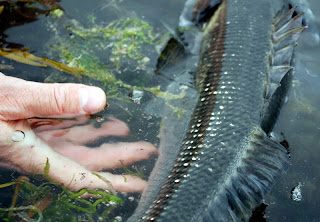 They are opportunistic feeders the vast majority of the time and in a good example of the range of sources that they can consider as food a recently caught fish contained a large cuttlefish, a giant sandeel and two hard backed crabs and was also in the process of eating a 7” senko worm which he considered as another item on the menu!
The capture and storing of ‘living’ energy is a full time job especially if you have competition from other members in your group trying to do the same thing!
Swimming along in a shoal of equally hungry fish their senses highly tuned to the capture of prey, the response to feeding opportunities is based around the following (not in any particular order)
In this (selective) instance fish are responsive to movement and take up positions to eat but then refuse to do so – other elements in the make up of ‘prey characteristics’ become part of the decision to eat or not – that secondary trigger might be any one of the elements above – shape size or colour.
Fish see colour during daylight hours only – their eyes have evolved to perceive contrast and movement in ways in which we cant – detail is not perceived. I often hear anglers say I cant catch something on a ‘hot pink lure’ but this is only because we are limited to – ‘this is how we see it in our world’.
Fish living in the multifaceted and fractured world of an underwater environment may on occasion perceive ‘hot pink’ against an underwater background or light much easier than a grey or an olive. It gives you an angling colour contrast edge. During opportunistic feeding times you as an angler are not necessarily trying to present lures or flies that are ‘naturally realistic’ in terms of finish, there’s no harm in this but its not always necessary.
During opportunistic times if fish can see something better or more obviously against an underwater background and current light conditions by virtue of contrast and you then combine this with good movement and animation you are on a winner. Remember prey is always trying to hide, be invisible, you as an angler are trying to present prey that is more obvious to predators - don’t make it more difficult than it already is.

The capture and storing of ‘living’ energy is a full time job especially if you have competition from other members in your group trying to do the same thing!
Swimming along in a shoal of equally hungry fish their senses highly tuned to the capture of prey, the response to feeding opportunities is based around the following (not in any particular order)
- Movement (or behaviour)
- Shape
- Size
- Colour
In this (selective) instance fish are responsive to movement and take up positions to eat but then refuse to do so – other elements in the make up of ‘prey characteristics’ become part of the decision to eat or not – that secondary trigger might be any one of the elements above – shape size or colour.
Fish see colour during daylight hours only – their eyes have evolved to perceive contrast and movement in ways in which we cant – detail is not perceived. I often hear anglers say I cant catch something on a ‘hot pink lure’ but this is only because we are limited to – ‘this is how we see it in our world’.
Fish living in the multifaceted and fractured world of an underwater environment may on occasion perceive ‘hot pink’ against an underwater background or light much easier than a grey or an olive. It gives you an angling colour contrast edge. During opportunistic feeding times you as an angler are not necessarily trying to present lures or flies that are ‘naturally realistic’ in terms of finish, there’s no harm in this but its not always necessary.
During opportunistic times if fish can see something better or more obviously against an underwater background and current light conditions by virtue of contrast and you then combine this with good movement and animation you are on a winner. Remember prey is always trying to hide, be invisible, you as an angler are trying to present prey that is more obvious to predators - don’t make it more difficult than it already is.
- Predatory fish respond to movement
- Predatory fish perceive contrast better than detail
- During opportunistic feeding times fish competing for food rely on less of the stimuli to eat your fly or lure
- Conditions will affect the way and where fish are feeding
- Behavioural movement imitation can be significant
- Make things easy for bass to eat your fly or lure
Sunday, 20 June 2010
NEVER judge a book by its cover

- Older lures in your box dont just stop catching fish
- Newer lures dont catch more fish
- Loss of a lure 'finish' doesnt affect a lures catch rate
- Loss of a lure 'finish' may in fact, enhance a lures catch rate
- Expensive lures are not neccessarily better than cheaper lures
- Price is not indicative of effectiveness
- Do not confuse 'lifelike' with 'realistic'
- Trigger points exist
- 'If it ain't chartreuse it ain't no use'.......what colour is the sun? for Bass its WHITE
- YOU are the lure
Friday, 21 May 2010


Thursday, 20 May 2010
Saltwater lure fishing - Part 14.2 of 21 - Rigging Softies - Wacky Style


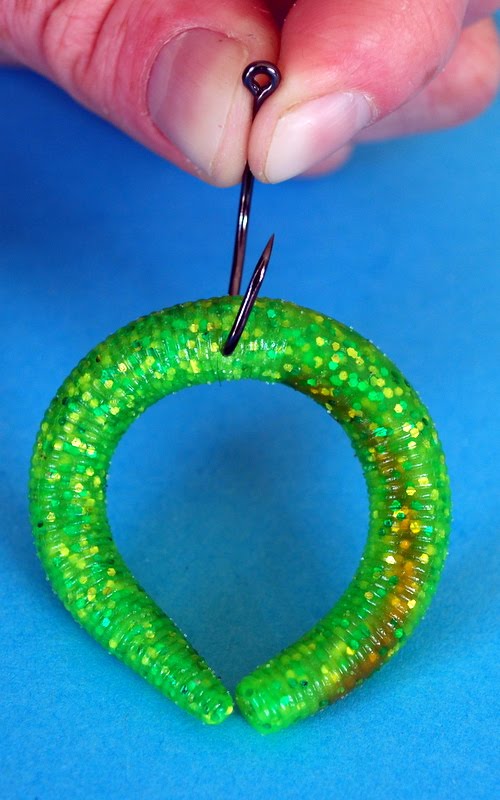
The Wacky Worm Rig
Senko worm
Nail weights (optional)
Gamakatsu circle
Alternative rig
Place a split ring over worm
(smaller diameter)
Move to mid point of worm
Place hook under split ring


Tuesday, 18 May 2010
Saltwater lure fishing - Part 14.1 of 21 - Rigging Softies
 Tools for rigging soft baits
Senko worm or wave worm
Split rings
Nail weights
Worm Hooks
Jig Heads
AR Rigs
Acoustic barrels

Monday, 17 May 2010
Rigging Soft Baits for Bass
 Later today and during the week - how to get the best from your soft baits for bass.
Rigging -
Jig Heads -
Weedless -
Tactics and techniques -
Friday, 16 April 2010
Saltwater Lure Fishing - Part 13 of 21 My Spring setup
 Since my posting about my basic set up for bass fly fishing in Wexford -What do I bring and what do I fish with? I have had lots of questions regarding my Lure fishing set up.
So in answer to your queries the following is a list of my basic personal Lure Fishing Bass Setup - Please click on the links for more details and diagrams/animations/help -
If all of this is new to you why not consider attending a dedicated Lure Fishing Workshop at SEAi – workshops are run on an individual basis on request
The Basics
The Reel – Shimano Twin Power 3500
The Rods – From SMITH
BS-90RS 9' 650mm 8~20lb 10~40g 245g 2 pieces – 141cm
BS-86SPL 8'6" 500mm 6~16lb 4~15g 173g 2 pieces – 134cm
The Line – Power pro 9kgs and 5kgs – with Rio Fluoroflex tippet
The Detail
I have pre-loaded 20 lbs BS Dacron fly fishing backing on both spools of the Shimano as I only carry 135 metres of braid (both spools loaded with different BS)
Bimini twist on the line end of the backing with a doubled over closing knot to provide double loops
Mainline powerpro braid tied to the backing using an Allbright knot to the double loops of the bimini
14lbs Fluoroflex is tied at the end of the mainline braid using a Reverse Allbright Knot
The leader BS and mainline BS depends on the rod / lure/ presentation I am making to the fish
I will place a rapala knot at the end of a one meter (varies) leader of Fluoroflex to attach to my lure
My go-to hard lure on a typical Spring day (depending on water clarity) would be a Lucky Craft pointer 78SP - view in full screen mode for best effect
I will fish with the BS-86 at this time of year (spring) with small soft lures and smaller sub-surface or surface lures and change up to the BS-90 only when necessary
The Gear
One small Fishpond waist Pack containing ALL of the following
Two small lure boxes one containing surface lures the other containing sub surface lures
One small lure box containing soft lures and various jig heads
One Fishpond nippers
One Stream works forceps
Spare tippet material
One spare spool loaded with alternate braided line
One pair of Sunglasses – Tan or yellow - NEVER leave without them
Small tube of sun factor
One waterproof camera
All the above available at www.thecoastalflyshop.com
Under / Wader Wear
all the following are breathable
Hellyhansen base layer - warm for this time of year
Patagonia insulator pants (maybe) Redington Fleece Vision Ikon Waders and Jacket – Vision boots (felt/stud)
Thursday, 14 January 2010

Sunday, 21 June 2009
Saltwater Lure fishing Tips - Part 12 of 21 - splash, bubble and POP.........


Theres more to poppers than you might think! Certainly casting a popper and working it back in the much described 'erratic fashion' does work, but do you find yourself wondering why some days are better than others?
Traditional technique - simpy cast you popper and let it land. Tighten down to your lure by winding a little line and when you see your lure moving a little then simply move your rod tip in a sharp pull - provided you are using braid and a reasonably stiffish rod you lure will generate a 'bow wave'. This bow wave is related to the type of movement you make with your rod arm and the size and shape of the concave face of your lure. Shorter snappier movements make different waves than longer strokes. Experiment with movements and lure shapes. Often an exaggerated or uncontrolled motion will see you lure turning end over end and fouling upon the mainline, with braid minimal movements create the most effective fishing.
Stop and go - Combining these movements above with periods of stopping the lure give the fish the opportunity to locate the source of all this disturbance. Constant popping with constant retriving whilst on occassion does produce fish will also cause you to miss many opportunities. Adding a stop creates a longer retrieve time and hence your lure is fishing for a longer period - time for fish to find it! Add stops for as long as twenty seconds if you can stand the suspense!
Bubble stream generation - Creating a bubble stream can often produce results where popping wont. A buuble stream is simply a long pull of the lure through the water causing a 'whoooshh' followed by a stop often just subsuface. Bass locate the lures through their well tuned senses and this technique creates both longer and different sounds coupled to a visual stream of bubbles.
Can you 'walk' a popper? - If you own the new generation of poppers then not only can you perform all of the above but you can also combine it with the 'walk the dog' technique. Some poppers are more difficult to walk than others, some are downright impossible but when you can achieve the combination of walk and pop its often unbeatable.
Not all poppers are created equal - The concave face of your popper is unique to the particular model. The angle that this face is presented at is also different across ranges of lures. Owning one popper doesnt mean 'you have a popper and dont need any more'. Sounds, shapes, splash types, even static presentations all make differences to your fishing on the day.
Saturday, 2 May 2009
Saltwater Lure Fishing Fundamentals for beginners
Saltwater Lure Fishing Series - First Published Irish Angler 2004
- Improve your saltwater lure fishing introduction.
- Lure and tackle choices.
- On the big blue.
Part three
So here we are at part three already. Lets talk a little about techniques. Remember from part two that we said traditional metal spinners like the Abu Toby are simply cast and then retrieved at various speeds. This is an effective way of catching fish no doubt. With a lure you can achieve so much more. By using the correct techniques you can impart more ‘life’ into a lure that a metal jig simply doesn’t have. To be really effective at lure fishing you need to develop two things – understanding how to locate the fish and ensuring you are using the right bait and techniques.
There are times during the day that are better than others, in fact there are two times, which are generally considered to be – early morning before the sun rises, and evening time, just before and after sun down. There is also a number of tidal factors to consider that may or may not correspond to this timing but from a beginners point of view I would advise you to try and determine the dates when rising tides coincide with a rising sun (not exactly of course) or, when rising tides coincide with a setting sun. These two co-incidences are proven times for fish catching, the change of light creates a hunting instinct in most predators. But don’t become restricted to these times only – there are other hours in the day too!
Regarding your search tactics for locations its up to you to put in the hard work and slog it out I’m afraid. It can take some time and effort. Getting up early, travelling long distances, trying various states of the tides. Expenditure on equipment and lures can run high. Sometimes it can be frustrating but eventually you will be rewarded. After your hard work you will have determined the patterns and success is yours to enjoy.
Ok so lets get to the serious stuff. This could take some time I’m afraid but lets begin. The equipment jigsaw consists of three main pieces, lets start with the reel. You will more likely than not be using a fixed spool reel. The activity of lure fishing means your reel will be in constant use during your fishing sessions. This is not like bait fishing where you cast and retrieve maybe every fifteen to twenty minutes, sixteen to twenty times in a session. When you are lure fishing you could probably be casting and retrieving as much as forty to fifty times and hour or two hundred times a session. This means your reel needs to be of good quality. Its internal workings need to be tough and smooth with correct bearing placement. The outer coating needs to be saltwater resistant and able to withstand the odd knock on rocks.
There is also one factor worth bearing in mind especially if you choose to use braid as your mainline, which I would recommend. When you retrieve braid onto your spool the line needs to be placed in neat parallel coils, this is achieved by a ‘slow oscillating’ mechanism within the reel. If you are purchasing a fixed spool reel for lure fishing look to for this or similar methods of line lay. The Shimano range is particularly suitable for this.
Your choice of mainline is one of two – traditional monofilament which is not too expensive or the more expensive option which is braid. I’m afraid I favour the latter for a number of reasons. Despite the initial outlay, if looked after properly braid will last three or four seasons. It has a much thinner profile than monofilament and hence will cast a lot further, there is another added benefit to this thin profile, it will help in the lifelike action of your lure. Braid has no stretch so there is a unique experience in fish and lure contact. This allows you to control your lure in ways that monofilament never can. When fishing with braid I would recommend that you use a short length of clear mono of fluorocarbon of about one metre at the end of your line. This allows for a little shock absorption when striking fish and prevents wear and tear on the braid from a lure or when fishing in rocky areas. Powerpro, spiderwire, Dynacable are all good brands that work really well. When using new braid take it easy with casting at first until you ‘break it in’ over one or two sessions. It is prone to wind knots at first but these will soon disappear.
The last piece of the jigsaw is your rod. A much talked about, and hotly debated topic. Lets look at the fish we are aiming to catch, sea trout, bass, mackerel, pollack. Not exactly huge fish are they. Ok so each has its particular strengths but these are not the hard fighting toothy species of the tropics. So matching your rod to the species you intend to catch will enhance your sporting experience. I have spent a considerable amount of time looking for suitable lure rods that fit the species to be caught in Ireland and generally I use two very light specialised saltwater rods. They are both of the same make. The first rod is an eight footer that casts lures between 10g and 30g, the second rod is just over nine feet and casts lures between 30g and 75g. It is important to mention that these are not classed in the traditional sense of the spinning rod. These are specifically designed saltwater lure fishing rods. Rings are Fuji sic and the carbon is of a very high modulus. Each rod has a specific line strength recommendation
The reaction that most people have to these rods is a how remarkably light and somewhat stiff they are, they then follow it up with the question how can you land a big fish on one of those? And herein lies a lot of information. These lure rods are constructed to do a number of things,
- They allow you to control and work you lure as effectively as possible
- They translate the movements of the lure into your hands and arms
- They allow you to cast a long way when required
- They allow you to apply power to a big fish when you need to avoid an obstruction and when you need to land the fish quickly
- Is sensitive and balanced enough to allow you feel the power of the fish
You don’t need a heavy spinning rod for fishing saltwater in Ireland. Travel light and enjoy the sense of freedom rather than becoming bogged down under the weight of your equipment. Enjoy the feeling of being in touch with your quarry and the sense that your effective equipment will put you closer to the fish and your fishing. This will allow you to enjoy your surroundings and learn from what you are witnessing in a more intimate and productive way.
I think we couldn’t finish this series without returning to the lures and some techniques. I’m afraid that in a short series like this it is simply not possible to cover every tactic or technique. The choice of lures facing the angler is huge so how does he select the correct one. Understanding the feeding habits of the target species will help, for instance sea trout are known to feed on sand eels at sea and in our estuaries. They are very wary of ‘artificials’ so a small light lure that resembles a sand eel closely and one that is fished n the correct manner will give you a lot of success. There is no point in targeting sea trout with large red lures that are designed for toothy critters.
Sea bass on the other hand are often aggressive and voracious hunters. They will respond to a number of stimuli and the ‘trigger’ points in many lures take advantage of this. Lures that splash and pop on the surface will attract bass, lures that flash and dive under cover will attract bass, and lures that bounce and crash into rocks will attract bass. Bass generally have no problems attacking large lures with big eyes that make lots of noise. If you have experienced a surface smash take by a big bass then you have experienced what makes this sport so addictive.
Learn to make you lure move realistically by watching bait fish in their natural environment. They don’t swim constantly in a straight line now do they? What colours of natural bait do you see watched up after the mackerel have attacked them? What kind of fish live under or close to the rocks where you are fishing, what colour are these guys, how do they behave, what does an injured fish look like in the water? What are the terns feeding on? It’s a case of constant observation and a applying what you see to your fishing.
Ensure you have a deep diving lure, a mid-water lure and a surface lure at all times. Animate your lure to enhance its swimming motion. Be confident in your lure choice and concentrate on what nature is telling you. Fish with a frame of mind that tells you - you will catch a fish on the next cast or the next or the next. Don’t mind the guy up the beach screaming at the bass he missed – its now swimming in your direction!
I must warn you that, and I’m sure you probably don’t need to be reminded of this that lures are an obsession. I have a few lures here at my house might I say, when I say a few I mean a large number. The fact is I only ever fish with about six or seven. The few that I fish with are firm favourites. They have all caught me a lot of fish, and they all have hundreds of fishing hours on them. On the odd occasion that I might loose one of them it’s a tragedy. There follows a little ceremony and a period of mourning whilst I decide how and with what I will replace my lost friend! Sad I know, but it will happen to you too! SEAi does provide counselling services for loss of loved lures!!
Subscribe to:
Posts (Atom)

